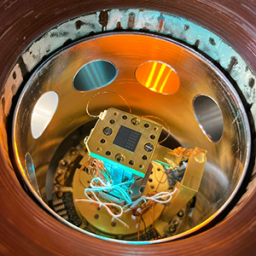
The National Physical Laboratory (NPL) has developed a miniaturised atomic fountain clock that could bring ultra-precise timekeeping technology into wider practical use across multiple industries.
The new research, published in Applied Physics Letters, demonstrates the successful operation of a radically simplified, compact atomic fountain clock. The breakthrough addresses long-standing challenges in positioning, navigation and timing (PNT) across sectors such as telecommunications, finance, defence and space.
Atomic fountain clocks are the world’s most accurate timekeepers, forming the basis of international time standards and supporting technologies like GPS and secure communications. Traditionally, however, their considerable size, cost and complexity have confined them to a handful of specialised labs worldwide.
NPL researchers have reduced the size of the clock’s physics package, the ultra-high vacuum system where atoms are cooled, launched and measured, by a factor of 20 compared with the UK’s current caesium fountain primary frequency standards.
“That’s taking it from barely being able to fit through a doorway to something one could pick up and carry with one arm,” said Dr Sam Walby, lead author of the study.
Despite its smaller footprint, the miniaturised fountain clock maintains comparable performance to full-scale systems, achieving a frequency stability of one part in 10¹⁵ after several days of averaging. Simplified optics and the use of commercially available fibre-coupled components also make the system easier to maintain and more reliable for long-term operation outside the lab.
The device is designed as an ultra-stable holdover solution, capable of maintaining timing errors below two nanoseconds per month. It can also function as a secondary frequency standard, helping realise the SI second with exceptional accuracy. This is a capability that’s becoming increasingly important for national resilience as threats to satellite-based timing systems grow.
“By radically simplifying and shrinking the atomic fountain, we’re making ultra-precise timing technology available beyond national labs,” Walby said. “This opens new possibilities for resilient infrastructure and next-generation navigation.”